


Versatile – a variety of topics presented to children in safe settings that help develop their skills and are great fun!
The content of each programme is adjusted to correspond to the children’s age group and is therefore available for different ages. However, the age group of the participating children or young people should range within certain limits to ensure content is most appropriate. Age groups are as follows: 4–6 years, 6–10 years, and 10+ years, although certain exceptions are possible. Parents may join and assist their young child, or take part themselves if the child asks.
In terms of time, there is also a certain range starting from a specific minimum duration, as some topics offer more scope or generally take longer to go through. This duration may be chosen from the minimum duration upwards! The venue must meet some requirements for the chosen activity, which are specified in the descriptions and will be discussed again in advance (e.g. access to water or a woodland...). Activities are offered in Linz (Upper Austria) and within a radius of approximately 100 km. Venues further away could also be included by individual arrangement.
The prices quoted are starting prices per child! If applicable: Participation by one accompanying parent per child is free of charge.
Please make enquiries (which are non-binding and free of charge) and bookings by telephone on 0676 334 63 68 or send a message!
For enquiries and bookings, please provide the following details:
1. Select the programme you are interested in (see list below)!
2. Please state the age range of the children and the total number (as precise as possible, excluding parents)!
3. Please specify the venue (which must meet the requirements as listed in the description), your preferred day of the event (options: Monday–Saturday) and the period of time you wish to book (minimum duration or longer; we can advise you on this)!
Generally, all details will be discussed to ensure that the event will be a success (i.e. that the children have a great time and valuable experiences can be provided)!
Based on the details discussed, an offer will be provided (verbally or in written form) which includes the price per child, covering travel to and from the venue, tools and materials specified, and the event. The offer is valid for one month and is immediately bookable.
In case of bad weather, we will work together to find a solution!
The General Terms and Conditions (GTC) for imparting knowledge about nature apply!
More programme highlights to follow – check back soon!
The simplest method is to place images made from materials from nature (leaves, twigs, soil, sand, etc.) on the floor. The second option is: we use a ‘base plate’ made of wood fibre, paper or similar materials and apply, glue or spread a layer of a medium such as plaster, sand, gravel or similar, onto which a picture can be painted using colours or created using materials from nature and coloured stones.
Whether with or without a base plate, here you’ll be laying things out, pressing, positioning, trying things out and more! The advantage of using a base plate is that you can take your artwork back home. Basic materials are partially provided (base plates, gravel, sand, coloured stones, paints…). And then: just unleash your creativity!
Children in a group can create one picture or several pictures, or they can split into groups of different sizes or work individually – anything is possible!
Requirements: Materials from nature from forest and meadow. Gravel, sand, crushed stone/stones and some water (a stream or water supply) should be available in close range. If you wish, please bring your own base plate made of paper, wood or similar materials, as well as paints, but let me know in advance. You must obtain the necessary permissions for the use of the sites and materials, for creating the artworks, for moving materials, and, where applicable, for leaving artworks in place, etc. by yourself!
Anything is possible! Whatever you want to create can be a success – if you need me, I’ll be there to support you!
Children/teenagers are encouraged to create a plot of land measuring a few square metres, which they can design as a miniature version from a bird’s-eye view using materials from nature. Using their imagination, they can create ‘bushes and trees’, lay out a meadow with flowers, a rockery or a vegetable garden, and in between, paths and perhaps even a ‘house’, the outline of which can be marked out. If they want to include a pond or a ‘stream’ with water flowing through the plot, just do it. In the end, the plot might contain all this and much more, depending on the creativity of the designers. There will be water in pond and it will flow through small streams. Necessary equipment will be provided (pipes, hoses, a pump if required, plastic sheeting/tarpaulins, some digging tools…) and removed at the end.
PLEASE NOTE: This activity is not intended for planting real vegetable seeds, flower seeds, bushes, etc.! Instead, stones and flowers and grass from a meadow can be used to decorate the rockery. The idea is to use your imagination to design a garden – to visualise what it might look like – using larger stones and smaller stones, grass, branches and twigs, and similar materials, whilst also moving materials such as sand and soil around.
Instead of, or in addition to, designing a garden plot, a landscape can also be created, again covering just a few square metres, on a smaller scale and viewed from a bird’s-eye perspective. Mountains, hills, the sea, a lake, a river, a forest… a landscape has endless possibilities. Ever built a volcano? You make whatever takes your pleasure! Necessary equipment for creating water bodies and flowing water in ‘rivers’ will be provided (pipes, hoses, a pump if required, plastic sheeting/tarpaulins, some digging tools…) and removed at the end.
Requirements: Materials from nature provided from woods and meadows. Soil, gravel, sand, crushed stone/stones and, where applicable, water (a stream or water supply). In addition, a location is required where the garden or landscape may be created. Water bodies and ‘rivers’ require the removal of a small amount of the surface layer (a few centimetres) or the creation of channels and the lining or paving with sheeting, stones, etc., which is done manually. Please bring your own digging tools (a large spade or small tools such as a garden spade, hoe, rake, etc.)! If you wish the artworks to stay in place, you may use your own materials. You must obtain the necessary permissions for the use of sites and materials, creating artworks, moving soil, and, where applicable, for leaving artworks in place, etc. by yourself!
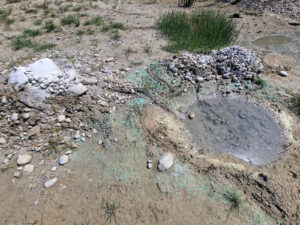
A simplified landscape featuring snow-capped mountains, a volcano, hills, a lake and watercourses (including a bridge). Older children and teenagers can try their hand at being designers even more by applying specific layers of soil, sand and other materials, adding watercourses with flowing water, and so on. You don’t have to do it all on your own – I’ll help you if you like! Build or design your own landscape and garden!
Everyone is allowed to build his own house or hut using materials found in nature and those provided (cardboard, textiles, straps, ratchet straps, tarpaulins, string, ropes…) – either on the floor or even slightly raised (max. 1 m above)! Make use of existing landscape features (slopes, trees, hollows…) and, if necessary, provide shelter from the sun, wind and rain! A settlement does not consist of houses, but also of paths between them and other spaces, e.g. ‘playgrounds’ and other communal areas, too. In addition, provided there is water nearby, you could supply your home with water and dispose of waste water via a drain.
Support will be provided, and, if necessary, there will be a brainstorming session at the start to discuss what could be built. At the end, everything will be removed, although if participants use their own materials, these structures may remain in place.
Requirements: Trees or a woodland are required in order to use them and build something raised off the ground. Materials from nature such as branches are generally useful. A water supply (a stream or water connection) is required to make a simple water pipe system. You must get permission yourself to set up the settlement in a particular location and, if necessary, to leave it at the end.
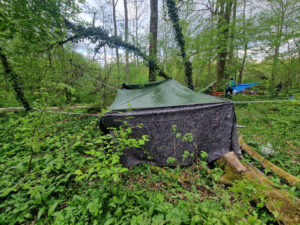
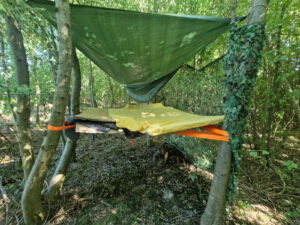
A shelter with a roof suspended from nearby trees, featuring walls and flooring inside. A shelter with a sleeping area at a height of approx. 1 m, capable of supporting well over 100 kg, with a sloping roof and a camouflage net. What does your ideal shelter look like? If you need help building it, I’ll be happy to assist!
This involves gathering the right materials from nature that will serve as burning material (fine, flammable and rough stuff), as well as finding proper places for starting a fire. Once you’ve found a proper spot – for example, in a fire bowl, on the ground or in a hollow in the ground – you get to try out different ways of starting a fire (e.g. using a shard of glass, a magnifying glass, a focusing lens, a fire steel and other methods)! There are different types of fire, each useful for different purposes (keeping warm, cooking, signalling and others) . We’ll set these up on a scale where only a small fire can be produced, and we’ll test them all to see if they fulfil their intended purpose. Cooking or frying something is one such purpose, and we’ll enjoy the result. Finally, we’ll consider how fire can be transported and put these ideas into practice to see if they work – though we won’t be travelling any distances.
Requirements: Materials from nature available from woods and meadows for starting a fire and keeping it alive. A fire bowl is helpful, if available, but not essential. Fires are lit on the ground and in a hollow in the ground, as the various types of fire require these options. A location or spot is required where all types of fire may be lit. Private property is generally more suitable than public spaces. Permission to light these generally (very) small fires must be obtained from the landowner! Various fire-starting tools (glass, magnifying glass, fire steel, etc.) will be provided.
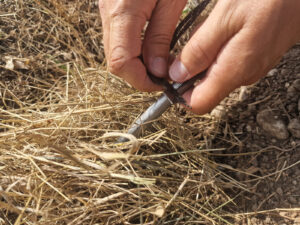
Light a fire in a cup made in the ground using fire steel and, hopefully, suitable striking material. Find necessary materials! What do you need to bear in mind concerning this? Are you able to light a fire using a magnifying glass, fire steel or some other method? If you are in need of support, there are explanations, demonstrations and letting you practise!
Using a range of construction materials such as pipes, channels, elbows, connectors, hoses, adaptors and shut-off valves, we’ll build one very large water pipe system or several smaller ones! Pumps help to deliver water, and we’ll then distribute it! Which team will build a water pipe system where water runs smoothly from one spot to another? It’s also exciting when different construction teams build sections of a water pipe that join to form a single pipe, or vice versa, where a single pipe splits into several pipes.
Filtering water to clarify water that has been dirtied by sediment is another part of the programme. We put together water filters and test whether water becomes cleaner again.
Requirements: There must be plenty of water available! Ideally, there is a stream or river that is easily accessible, and terrain that allows the installation of a water pipe system. All pipes, connectors, hoses, adaptors and shut-off valves will be provided, as well as pumps and fixing materials (string, adhesive tape)!
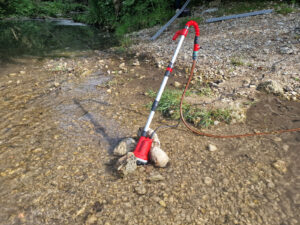
A water pump in the stream to supply elevated areas with water via a water supply system. Build your own one – with help or on your own!
The ultimate programme – and you pick it!
You’ll build your shelter, have fun doing everything around the fire, set up your water supply, and finally, round off the day by gathering round the campfire together!
You create your garden and, on top of that, a landscape featuring a mountain range, a mountain river, hills, a forest and a lake. Then you build a water supply system with a shower and have fun with water fights using garden hoses.
You arrange a picture on the floor using leaves, pieces of bark, branches and twigs, add a layer of soil, sand or gravel, and then colour in some of the elements. Now you’ve created a landscape with trees, clouds, the sun and a lake. Alternatively, you can use a cardboard base onto which you apply a layer of plaster and put small stones into it; once the plaster has set, you can paint them. Afterwards, you can build a small shelter on the ground nearby from where you can admire your artwork, or, in case you used a base plate, place it in the shelter.
Choose the combination of activities you’d like to include in your programme! Whatever you decide to do, just make sure you’re the right age for all the activities you’ve chosen! If that’s not quite the case, we might be able to make an exception. However, this doesn’t apply to activities involving fire!
Requirements: All the specified requirements for all selected programme components apply together!
More programme highlights to follow – check back soon!


 English (UK)
  Deutsch